One sudden power outage can erase hours of work, crash a server, or shut down critical medical equipment. A UPS battery sits between your devices and the wall outlet, ready to deliver emergency power the instant utility electricity fails. It’s the core component that turns an Uninterruptible Power Supply (UPS) from a simple surge protector into a life-saving backup system.
In this guide, you’ll learn exactly what a UPS battery does, how different UPS topologies use it, what battery technologies exist today, and how to pick the right system for your home, office, or data center. Whether you’re protecting a single router or an entire server rack, understanding UPS batteries helps you avoid costly downtime and equipment damage.
What a UPS Battery Actually Does
Instant Emergency Power When Outages Strike
The primary job of a UPS battery is to take over the moment utility power drops, spikes, or cuts out completely. Unlike standby generators that need seconds (or minutes) to spin up, a UPS battery activates within milliseconds. Most systems provide 5 to 15 minutes of runtime, which is enough to save files, shut down servers safely, or switch to a longer-term generator.
UPS batteries don’t just keep the lights on. They prevent data corruption in computers, protect sensitive electronics from voltage swings, and maintain continuous operation for equipment where even a brief interruption could cause harm or major financial loss.
Power Conditioning Beyond Simple Backup
A UPS battery is part of a system that actively cleans incoming electricity. The battery works with an inverter to correct problems like:
- Voltage sags and surges
- Electrical noise and transients
- Harmonic distortion
- Frequency instability
This dual role makes a UPS both a battery backup and a power quality conditioner. The specific conditioning features depend on the UPS topology, which determines how and when the battery engages.
Runtime Depends on Load and Battery Size
Battery runtime isn’t fixed. It changes based on:
- Load size: Higher wattage draws drain the battery faster
- Battery capacity: Measured in amp-hours (Ah) or watt-hours (Wh)
- Discharge rate: Lead-acid batteries deliver less usable capacity under heavy loads (governed by Peukert’s Law)
- Inverter efficiency: Typically 85–95%, which affects how much stored energy reaches your devices
Manufacturers list estimated runtimes (such as “10 minutes at half load”), but real-world results vary based on actual conditions and battery age.
Three Types of UPS Systems and How They Use Batteries
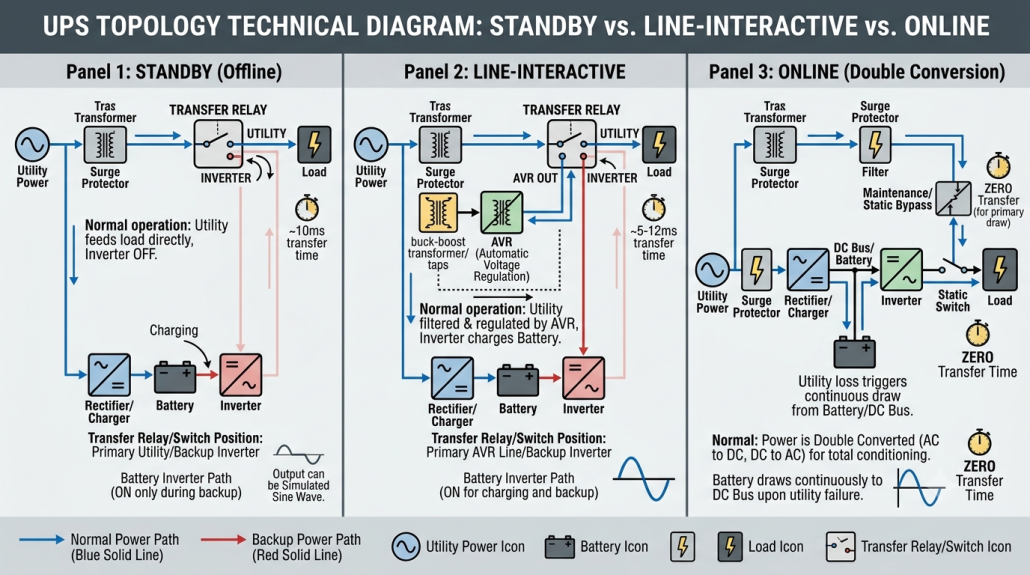
Standby (Offline) UPS: Basic Home Protection
A standby UPS passes utility power straight through to your devices until a problem is detected. When voltage drops too low or spikes too high, the system switches to battery power using an internal inverter. This switch takes 10–25 milliseconds, which is fast enough for most home electronics but can cause sensitive servers or network storage devices to reset.
Best suited for:
– Home offices
– Printers and routers
– Non-critical electronics
Key limitations:
– No voltage regulation
– Minimal noise filtering
– Brief transfer time during switchover
Standby units are the most affordable UPS option and work well where brief interruptions are acceptable.
Line-Interactive UPS: Smarter Voltage Correction
A line-interactive UPS improves on the standby design with an autotransformer that adjusts voltage automatically without touching the battery. If input voltage sags to 100V, the UPS “boosts” it to 120V. If input rises to 135V, it “bucks” it down. This Automatic Voltage Regulation (AVR) handles common brownouts and overvoltages while preserving battery life for actual outages.
Best suited for:
– Small businesses
– Network closets
– Areas with unstable grid voltage
Key advantages:
– Better protection than standby
– Battery only activates during full outages or extreme events
– Efficient under normal conditions
Online (Double-Conversion) UPS: Maximum Protection for Critical Loads
An online UPS continuously converts incoming AC power to DC, then back to clean AC, using the battery as part of the permanent power path. Because the inverter runs at all times, there is zero transfer time during an outage. The battery simply takes over seamlessly when utility power fails.
How it works:
1. AC enters and reaches a rectifier (converts to DC)
2. DC charges the battery and powers the inverter (converts back to clean AC)
3. Output is a pure sine wave, fully isolated from input disturbances
Best suited for:
– Data centers
– Medical equipment
– Industrial control systems
– Financial transaction servers
Online UPS systems cost more and run slightly less efficiently due to constant power conversion, but they provide complete electrical isolation and eliminate virtually all power quality issues.
Battery Technologies Used in UPS Systems
Valve-Regulated Lead-Acid (VRLA): The Industry Standard
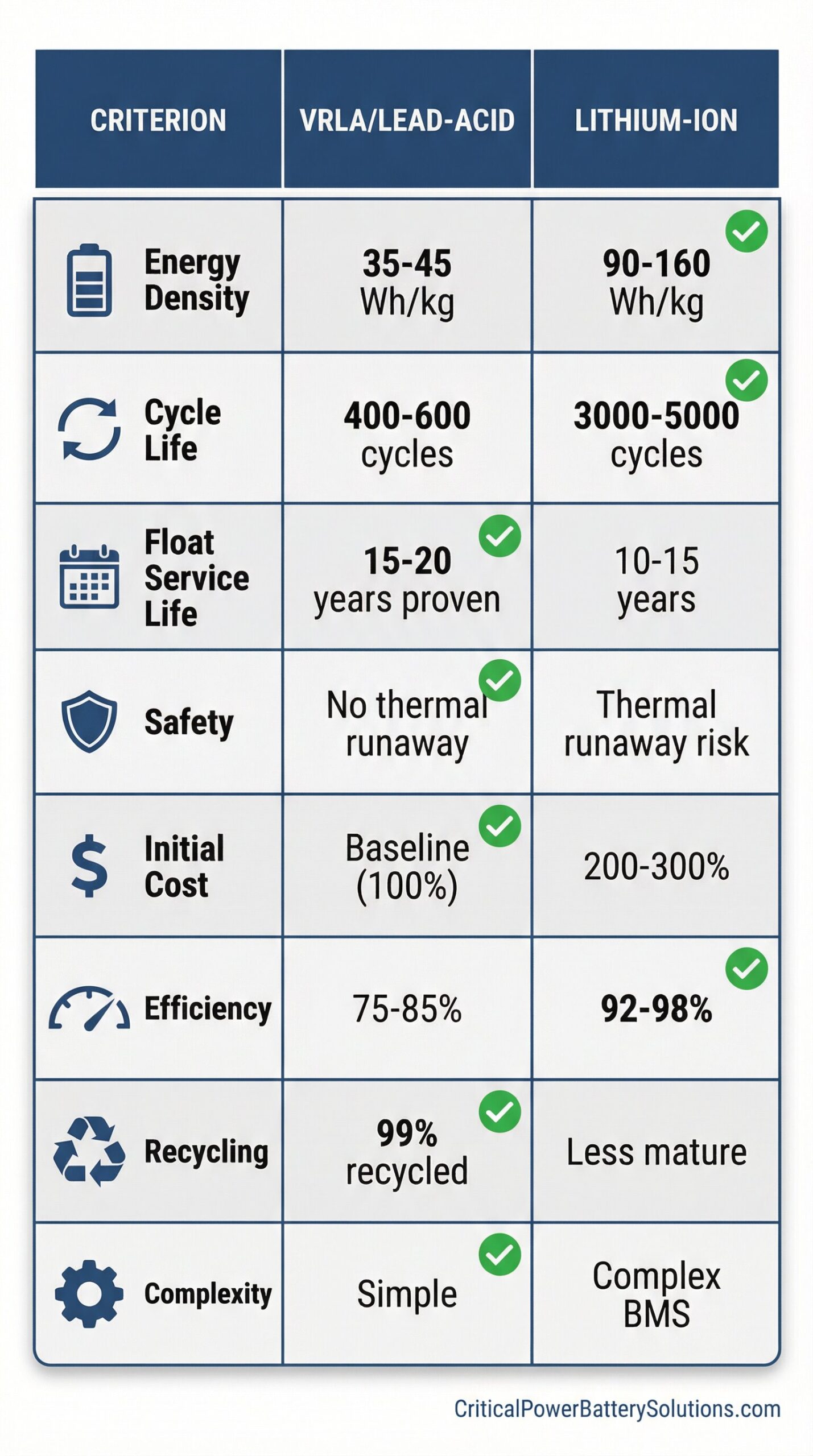
VRLA batteries dominate the UPS market because they’re affordable, sealed, and maintenance-free. They use recombinant gas technology to prevent water loss and can be installed in any orientation, making them ideal for indoor environments.
Key characteristics:
– Typical lifespan of 3–5 years
– Sensitive to heat (lifespan halves for every 10°C above 25°C)
– Found in roughly 90% of consumer and small business UPS units
Limitations:
– Lower cycle life than lithium alternatives
– Slower recharge (often 8+ hours)
– Bulkier and heavier
VRLA batteries are easy to replace and widely available, which keeps them popular for standard UPS applications.
Flooded Cell (VLA) Batteries: Industrial-Grade Durability
Also called vented lead-acid (VLA) batteries, these are built for large, mission-critical installations like telecom hubs and utility substations. They last 10–20 years and tolerate deep discharges better than VRLA batteries.
Drawbacks:
– Require ventilation because they emit hydrogen gas
– Need regular maintenance, including adding distilled water
– Must remain upright in dedicated battery rooms
VLA batteries are reserved for professional environments with trained staff who can handle the safety and maintenance requirements.
Lithium-Ion (LFP) Batteries: The Next Generation
Since the mid-2020s, lithium iron phosphate (LFP) batteries have gained serious traction in data centers and AI infrastructure. They offer significant advantages over lead-acid:
- 2–3x longer lifespan (8–10+ years)
- 50–70% smaller footprint
- Faster recharge (2–3 hours vs. 8+ for lead-acid)
- Higher cycle life (2,000–5,000 cycles vs. 300–500 for VRLA)
Though more expensive upfront, LFP batteries often deliver lower total cost of ownership over time due to reduced replacement frequency, smaller cooling needs, and higher energy density. As prices continue to drop, lithium-ion is expected to replace lead-acid in many commercial applications.
How UPS Batteries Are Wired Together
Series Connections for Higher Voltage
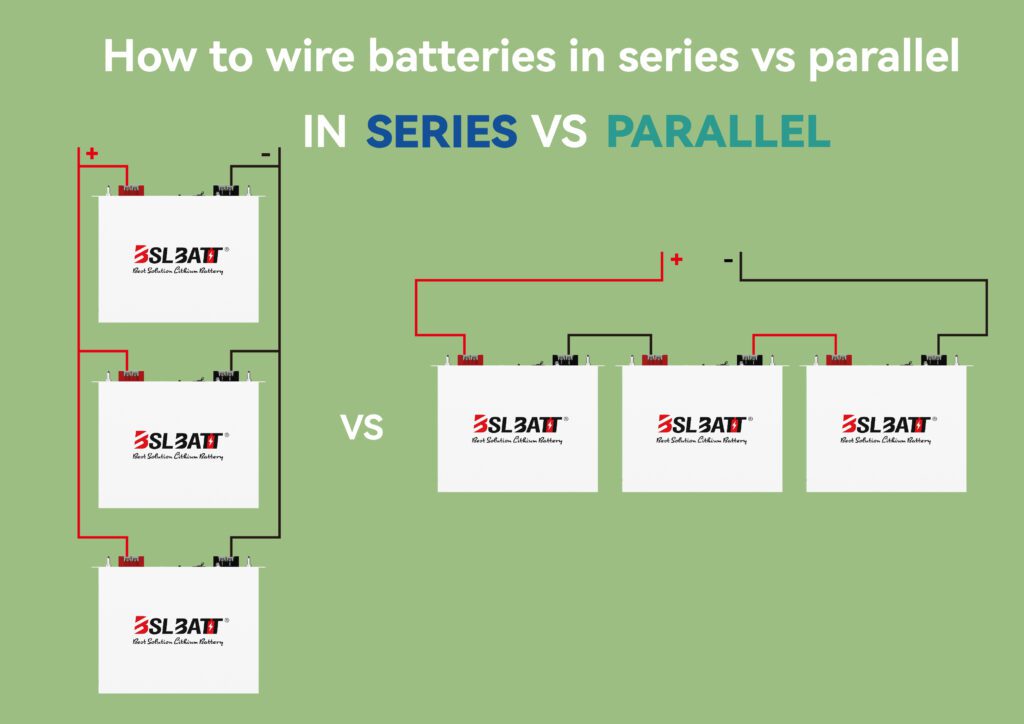
Batteries are wired in series to increase output voltage. For example, four 12V batteries in series create a 48V system common in telecom and industrial UPS setups. Each battery adds its voltage while current stays the same. A single failed battery breaks the entire string, so monitoring is essential.
Parallel Strings for Longer Runtime
Connecting battery strings in parallel increases capacity (Ah) and extends runtime. Two 12V, 100Ah batteries in parallel deliver 12V at 200Ah, effectively doubling how long the UPS can run.
Parallel configurations come with risks:
– Uneven current sharing between strings
– Stronger strings discharging into weaker ones
– Hidden cell failures that affect the whole system
To prevent cascading failures, some experts recommend avoiding parallel strings or using individual charge controllers per string.
Series-Parallel Combinations for Large Systems
Large UPS installations often combine series and parallel wiring to scale both voltage and capacity. For instance, two strings of four 12V batteries each produce a 48V system with double the amp-hours of a single string. These arrangements require careful balancing and monitoring at both cell and string levels to prevent premature aging or thermal runaway.
Testing and Maintaining UPS Batteries
Why Self-Tests Can Give False Confidence
Most UPS units run automatic self-tests weekly or monthly, lasting only a few seconds. While these tests catch completely dead batteries, they only measure interface charge, the surface-level voltage that doesn’t reflect true capacity.
A battery might pass a self-test but fail under real load because:
– The chemical reaction hasn’t diffused through the plates
– Internal resistance has increased over time
– Sulfation has reduced the active material available
Deep Discharge Testing for Accurate Results
A rundown test fully discharges the battery to measure actual runtime. This reveals true capacity, helps recalibrate runtime estimates, and identifies weak cells early. However, deep discharge testing causes sulfation in lead-acid batteries, which permanently reduces capacity if done too often.
Recommended frequency: Perform deep discharge tests every 6–12 months to balance accuracy with battery preservation.
Individual Cell Monitoring in Large Battery Banks
In multi-kilowatt commercial UPS systems, sensor wires between cells allow real-time monitoring of voltage, temperature, and internal resistance at each cell. This enables early detection of failing cells, imbalanced charging, and overheating, which is critical for maintaining uptime in data centers and industrial facilities.
Power Quality Issues That UPS Batteries Help Solve
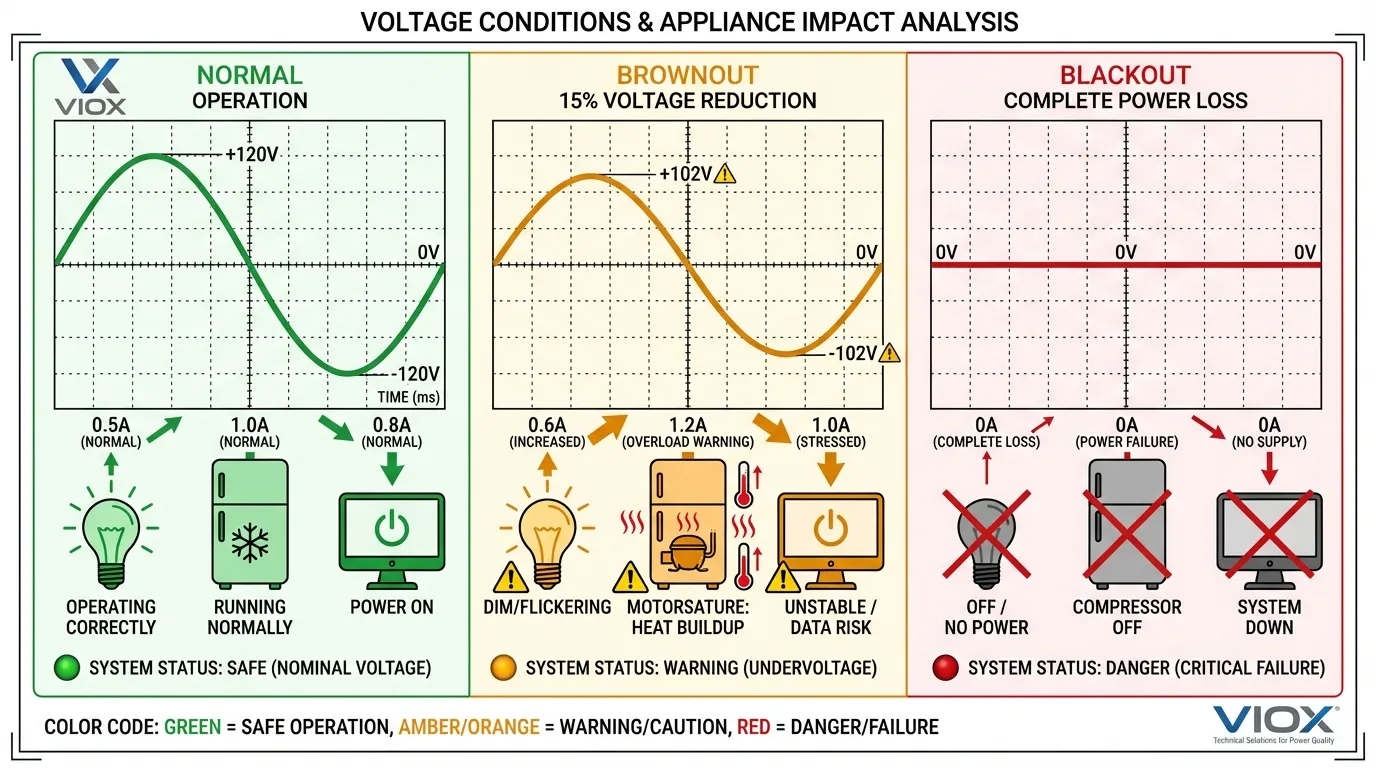
Common Power Problems Addressed
A UPS corrects many utility power issues, depending on its topology:
- Voltage spike or sustained overvoltage
- Brownout (momentary or sustained voltage reduction)
- Voltage sag (brief drop below nominal levels)
- Electrical noise and transients from nearby equipment
- Frequency instability in the mains supply
- Harmonic distortion from non-linear loads
Standby UPS units handle the basics (outages, surges). Line-interactive models add voltage regulation. Online UPS systems correct nearly all power quality issues, including noise, harmonics, and frequency variations.
Harmonic Distortion in Double-Conversion UPS
Online UPS systems draw non-sinusoidal current, creating Total Harmonic Distortion (THDI). Classic rectifiers produce 25–30% THDI, which can overheat generators and transformers. Modern IGBT rectifiers reduce THDI to less than 5%, eliminating the need to oversize backup generators and simplifying system design.
Communication and Remote Management
Monitoring via USB, SNMP, or GSM
Modern UPS systems connect to networks for remote monitoring and management. Common interfaces include:
- USB: Connects to a single computer for shutdown coordination
- Ethernet + SNMP: Enables enterprise-wide monitoring across many devices
- GSM/GPRS: Sends alerts via SMS in off-grid or remote locations
These connections allow automatic server shutdown, email alerts, and integration with building management systems.
One-to-Many Signaling Challenges
A single large UPS often protects multiple servers, but standard USB and serial connections only support one-to-one communication. Solutions include:
- Signal splitters that broadcast status to multiple devices
- SNMP cards that enable TCP/IP communication with many systems
- GSM modems that send shutdown commands over cellular networks
All intermediary devices (switches, routers) must also be UPS-protected to ensure alerts reach their targets during an outage.
Choosing the Right UPS Battery for Your Needs
Match the UPS Type to Your Application
| Use Case | Recommended UPS Type |
|---|---|
| Home office, router | Standby |
| Small business, NAS | Line-Interactive |
| Server room, clinic | Online (double-conversion) |
| Data center, AI rack | Online with LFP battery |
Consider Total Cost of Ownership
While VRLA batteries cost less upfront, lithium-ion options often save money over a 10-year span through fewer replacements, reduced cooling requirements, smaller footprint, and faster recharge. Evaluate based on lifespan, maintenance needs, and space constraints, not just purchase price.
Plan for Environmental and Redundancy Needs
For outdoor installations:
– Choose IP-rated enclosures to handle weather
– Include battery heaters for cold climates
– Add cooling fans or air conditioning for hot environments
For mission-critical loads:
– Use N+1 redundancy (one extra module beyond what’s needed)
– Or 2N configuration (fully duplicated systems)
– Connect dual-power servers to separate UPS units
Frequently Asked Questions About UPS Batteries
What is the main purpose of a UPS battery?
A UPS battery provides emergency power to connected devices when utility electricity fails. It activates within milliseconds to prevent data loss, hardware damage, or operational downtime during outages, surges, or voltage fluctuations.
How long does a UPS battery typically last during an outage?
Most UPS batteries provide 5 to 15 minutes of runtime, depending on the load size and battery capacity. This is usually enough time to save work, shut down equipment safely, or switch to a backup generator.
What’s the difference between VRLA and lithium-ion UPS batteries?
VRLA batteries are cheaper and widely available but last 3–5 years with 300–500 cycles. Lithium-ion (LFP) batteries last 8–10+ years with 2,000–5,000 cycles, recharge faster, and occupy less space, but cost more initially.
Can a UPS battery protect against power surges?
Yes. All UPS types provide some level of surge protection. Standby and line-interactive models handle basic spikes, while online UPS systems offer the most complete protection against surges, noise, and harmonics.
Why do UPS self-tests sometimes miss bad batteries?
Brief self-tests only measure interface charge, which is the surface-level voltage that develops quickly during charging. True battery capacity depends on chemical diffusion throughout the plates, which takes longer to assess. A deep discharge (rundown) test is needed for accurate evaluation.
How often should I replace my UPS battery?
VRLA batteries typically need replacement every 3–5 years. Lithium-ion batteries can last 8–10+ years. Battery age, operating temperature, and discharge frequency all affect actual lifespan. Replace batteries when runtime drops significantly or self-tests fail.
Final Takeaways on UPS Batteries
A UPS battery is far more than a simple backup. It’s the heart of a sophisticated power protection system that keeps critical equipment running through outages, surges, and voltage instability. Understanding the three main UPS topologies (standby, line-interactive, and online) helps you match protection level to application sensitivity.
Battery technology matters just as much. VRLA remains the standard for affordability and availability, while lithium-ion offers compelling long-term value for data centers and high-demand environments. Proper maintenance, including occasional deep discharge testing and individual cell monitoring in large systems, ensures your UPS delivers reliable protection when you need it most.
Start by assessing what you’re protecting: a home router needs a basic standby UPS, while a server room or medical facility demands an online double-conversion system with the right battery chemistry. Matching the UPS battery to your load sensitivity, environment, and budget ensures reliability when it matters most.